
China Top cigar display cases Wholesale for Global Buyers reflects a practical shift in premium retail presentation. Grand View Research estimates that the global cigar market will continue expanding through 2030, supported by premiumization and specialty retail demand. The Cigar Association of America also reports billions of cigars shipped annually in the United States. These figures do not isolate cigar display cases. That limitation matters. Still, they show why secure, attractive presentation equipment deserves closer attention.
Zino Davidoff, a respected cigar-industry pioneer, is widely credited with saying, “The pleasure of smoking a cigar is not in the smoking, but in the preparation.” His observation also applies to presentation. A well-built cigar display case frames the product before purchase. Clear glass, stable hinges, polished wood, and controlled interior conditions create visible confidence. Buyers should inspect more than appearance. They need to check seal quality, humidity compatibility, lighting temperature, packing protection, and export documentation. Experience shows that small details matter. A loose door can damage the whole impression.
Chinese manufacturers now offer wholesale options for retailers, hotels, lounges, and distributors. Many provide OEM dimensions, logo engraving, adjustable shelves, and different wood finishes. However, lower prices do not always mean better value. Material certificates, production samples, inspection records, and after-sales support should guide comparisons. The strongest supplier is not always the cheapest one. It is the one that delivers consistent construction across repeated orders. That point sounds obvious, yet buyers sometimes learn it too late.
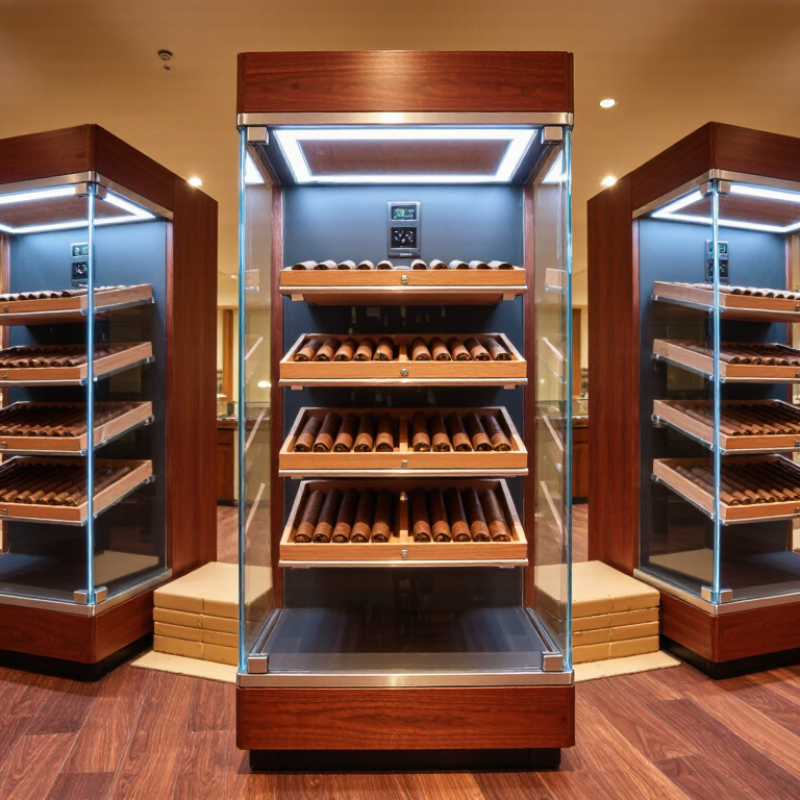
For global buyers, a cigar display case is more than a polished cabinet. Its main job is to hold stable storage conditions. A reliable target is 65–72% relative humidity and 16–20°C. These ranges help preserve wrapper texture, aroma, and burn quality. Humidity that falls too low can make cigars brittle. Excess moisture may encourage mold and uneven burning. Temperature matters too. Warm, damp air accelerates aging and creates avoidable risk.
During wholesale evaluation, inspect door seals, tray spacing, lining, hinges, and ventilation paths. A tight seal limits moisture swings, while calibrated digital sensors reveal changes that feel invisible. Do not trust one reading. Place sensors at upper and lower levels, then compare them after 24 hours. In practical inspections, repeated opening can shift humidity quickly. That detail is easy to overlook. Some buyers focus on appearance and regret ignoring the climate system. A beautiful case cannot correct unstable air. Perfect stability is not realistic.
Tips: Let the empty case stabilize before loading it. Calibrate the hygrometer, check it weekly, and record readings. Keep the case away from windows, heaters, kitchens, and direct airflow. Add humidity slowly; more is not always better. If readings remain unstable, review the seal and sensor placement before changing everything. Leave a small buffer below the maximum RH target, because household conditions are rarely perfect.
| Storage Dimension | Recommended Target | Practical Operating Range | Wholesale Buyer and User Guidance |
|---|---|---|---|
| Relative Humidity | 65–72% RH | Approximately 62–75% RH | Stable humidity helps preserve cigar flexibility and reduces the risk of excessive dryness or over-humidification. Avoid rapid humidity fluctuations inside the display case. |
| Temperature | 16–20°C | About 15–21°C | A cool, stable environment supports long-term storage. Keep the case away from direct sunlight, radiators, heating vents, and other sources of heat. |
| Humidity Stability | Minimal daily variation | Preferably within 2–3 percentage points per day | Consistency is generally more important than repeatedly correcting small deviations. Open the case only when necessary and close it securely after access. |
| Temperature Stability | Steady conditions | Avoid frequent changes greater than 2–3°C | Sudden temperature changes can affect relative humidity and may increase condensation risk. Allow the case to acclimate gradually after transport or installation. |
| Monitoring Equipment | Digital hygrometer and thermometer | Continuous or routine monitoring | Place the measuring device where air can circulate freely and where it is not directly exposed to a humidifier, water source, glass wall, or exterior heat. |
| Hygrometer Verification | Regular accuracy checks | Check periodically and after long-distance shipping | Verify readings with a suitable calibration method or a trusted reference instrument. Replace or recalibrate sensors that show persistent abnormal readings. |
| Air Circulation | Gentle, even circulation | No strong direct airflow | Adequate circulation helps reduce localized wet or dry zones. Do not position cigars directly against vents or in front of a humidification outlet. |
| Cigar Arrangement | Organized with small air gaps | Avoid dense compression | Leave enough space for air movement and inspection. Rotate or rearrange stored cigars when needed so the same items are not permanently closest to the humidification source. |
| Light Exposure | Low-light or shaded placement | Avoid direct UV and sunlight | A shaded display location helps limit heat buildup and protects the appearance of the case and cigar wrappers. Tinted or UV-reducing glass can be considered where appropriate. |
| Ventilation and Sealing | Controlled airflow with a reliable seal | No visible gaps or uncontrolled drafts | The case should retain humidity while allowing appropriate air exchange. Inspect door seals, hinges, and cable openings during installation and maintenance. |
| Condensation Control | No standing moisture | Dry interior surfaces | Condensation indicates a temperature or humidity imbalance. Pause humidification if necessary, improve circulation, and restore stable conditions before placing cigars back inside. |
| Transport and Delivery | Gradual acclimatization | Allow several hours before final setup | After international shipment, unpack the display case in a dry, shaded area and allow materials, seals, and electronic components to reach room conditions before loading cigars. |
| Maintenance Frequency | Routine inspection | Inspect monthly or according to usage | Check humidity readings, temperature, seals, shelves, water reservoirs, and interior cleanliness. Maintenance intervals should be shortened for high-traffic retail environments. |