Choosing the best Acoustic Panels starts with a simple question: what sound problem are you trying to solve? A meeting room with sharp echoes needs a different treatment from a music studio or a noisy open office. Wall panels absorb reflected sound; they do not automatically block noise passing through walls. That distinction is easy to miss.
The U.S. Environmental Protection Agency’s report, Information on Levels of Environmental Noise Requisite to Protect Public Health and Welfare, identifies speech interference as one effect of unwanted noise. For room performance, ANSI/ASA S12.60 sets a maximum reverberation time of 0.6 seconds for certain unoccupied classrooms. These references offer useful context, though they do not prescribe one panel type for every room. Grand View Research’s acoustic insulation market analysis also tracks growing demand for sound-control materials; insulation and room-treatment panels, however, serve different purposes.
Listen to the room.
Sound expert Julian Treasure said in his TED talk, “We are losing our listening.” His reminder suits panel selection: notice where speech blurs, where claps ring, and where sound feels harsh. Then compare material, thickness, coverage, mounting method, and tested absorption data. A fabric-wrapped fiberglass panel may suit one space; wood slats with an absorptive backing may better fit another. NRC ratings can help, but they are not the whole story. Placement matters. So does the room’s shape. Even a well-chosen panel can disappoint when installed without a clear plan. The right choice is less about a fashionable finish and more about measured needs, honest product specifications, and the room’s everyday use.
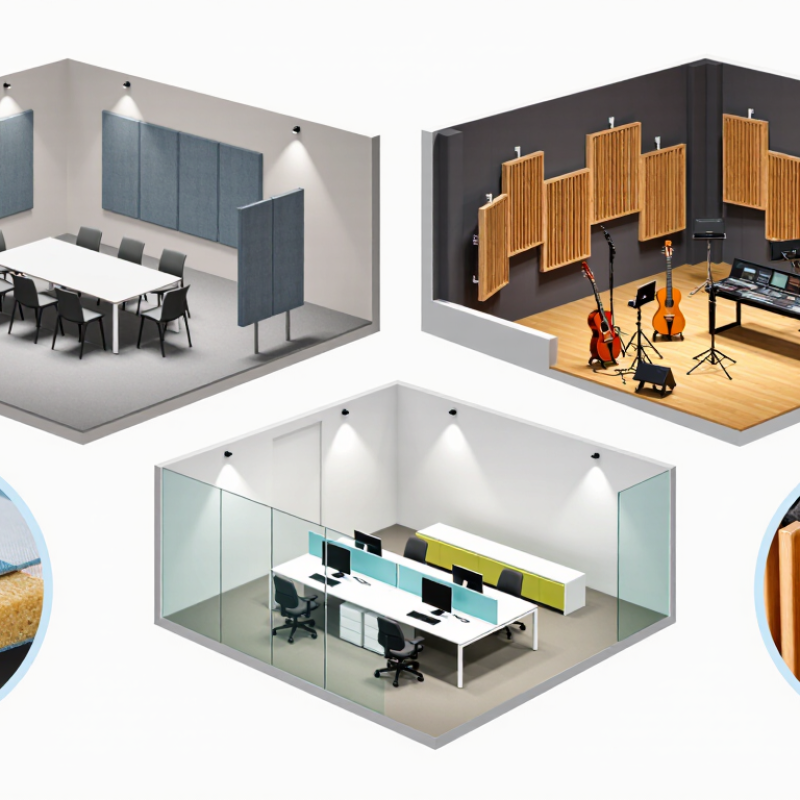
Acoustic panels control reflections by converting some sound energy into heat within porous material. Fabric-wrapped mineral-wool or fiberglass panels work well for this; thin foam mainly absorbs higher frequencies, so it may leave bass buildup untouched. Panels do not soundproof a room. They reduce echoes and shorten reverberation, while sound isolation needs a different construction approach.
Placement matters. A useful starting point is the “first reflection” spots: have someone move a mirror along the side wall while you sit at the listening position, then place panels where you can see the speakers. Add treatment to the rear wall or ceiling if sharp echoes remain. The Sabine equation, used in architectural acoustics, relates reverberation time to room volume and total sound absorption. For context, ANSI/ASA S12.60 sets a maximum reverberation time of 0.6 seconds for core learning spaces up to 10,000 cubic feet, averaged across key speech frequencies. This is a design benchmark, not a universal target for every room. Too much absorption can make a space feel unnaturally dull. Sometimes it still does. Check panel absorption test data, such as measurements made under ASTM C423, and judge the room by listening as well as by specifications.
Acoustic panels differ by what they absorb, how they are built, and where they work best. Fabric-wrapped panels with mineral wool or fiberglass cores absorb a broad range of sound, especially when they are thick enough and spaced slightly away from the wall. They suit studios, meeting rooms, and echo-prone living spaces. Foam panels are lighter and easier to cut, but thin foam mainly reduces sharper reflections. It will not fix deep bass by itself. Bass traps use greater depth, often in corners, to help control low-frequency buildup. Diffusers scatter reflections rather than absorbing much sound, so they serve a different purpose.
Tips: Listen before you buy. Clap near a bare wall and notice the sharp echo, then check again after placing a panel. Use thicker panels for lower frequencies, and treat the first reflection points beside your listening position. Avoid covering every surface; a room can become unnaturally dull. Small placement changes matter. Results vary with room size, furnishings, and panel installation, so one popular layout may not work in your space. I would measure and adjust gradually, because predicting the exact result from a product description alone is imperfect.
Acoustic panels differ mainly in how air moves through their cores. Fiberglass and mineral wool are porous absorbers: sound enters the fibers and loses energy through friction. ASTM C423 laboratory reports commonly show 50-mm panels in these materials with Noise Reduction Coefficient (NRC) values around 0.85–1.00, depending on density, facing, and mounting. NRC averages absorption at 250, 500, 1,000, and 2,000 Hz. Useful, but incomplete: it does not describe bass performance well.
Polyester-fiber panels are lighter and easier to cut, and their absorption varies with thickness and fiber structure. A 25-mm panel may control speech reflections, yet leave a low hum largely untouched. Open-cell acoustic foam also absorbs mid- and high-frequency sound; thin foam is less effective at lower frequencies. Check a product’s ASTM C423 test report rather than judging by appearance. Two panels that look alike can measure differently.
Perforated wood or metal panels work differently. Sound passes through their openings into a cavity, where a porous backing absorbs it. The cavity depth matters. A deeper air gap can improve lower-frequency absorption, while a tightly mounted, shallow panel may mainly soften brighter reflections. ISO 354 and ASTM C423 laboratory methods help compare tested products, but room results still depend on placement and coverage. Small rooms are especially unforgiving. I would not choose by NRC alone.
Choose panels by the problem you hear, not by appearance alone. In a bright home office, speech may sound sharp because hard walls reflect mid- and high-frequency sound. Fabric-wrapped mineral wool or fiberglass panels can reduce those reflections when placed near the desk or behind the listener. A hand clap can reveal flutter echoes. A small test helps.
Foam panels are light and easy to mount, but thin foam mainly absorbs higher frequencies. It rarely controls deep bass or blocks noise from neighbors. For a music room with a boomy low end, thicker broadband panels or corner bass traps are more useful. Place traps where walls meet. An air gap behind wall panels can also improve low-frequency absorption.
Some rooms need balance, not maximum absorption. Wood-slat panels with an absorptive backing can soften reflections while keeping the room lively; results depend on the design. In a dining room, ceiling panels above the table may help conversation more than covering every wall. Listen from the seats people actually use. Panels do not soundproof a room. That distinction is easy to miss. Furniture and room shape affect results, so try one area before treating the whole space.
Representative sound absorption coefficients by frequency band
Higher coefficients indicate more sound absorbed. Thicker porous panels generally absorb lower frequencies more effectively, while thinner panels are often most useful for mid- and high-frequency reflections. Values are representative lab-test figures; actual performance varies with materials, thickness, mounting, and room conditions.
Acoustic panels work best where sound reflections cause a real problem, not simply wherever a wall is empty. Sit in the usual listening position and have someone move a small mirror along each side wall. When you can see a speaker in the mirror, that spot marks an early reflection point. A panel there can reduce distracting echoes and improve stereo clarity. A ceiling cloud may help too, especially in a room with hard floors and a low ceiling.
Coverage matters as much as placement. A few panels spaced across key reflection areas often preserve a more natural sound than covering every surface. Too much absorption can make a room feel oddly dull. I used to think more panels meant better control; that assumption misses the room’s size, furnishings, and use. Thick panels with an air gap can absorb lower frequencies more effectively than thin panels, but ordinary wall panels will not solve every bass problem. Start with a small, measured area. Listen to speech and music, then adjust. Room changes can be subtle. Keep notes; memory is unreliable.
| Panel Type | Best Suited For | Frequency Behavior | Placement That Often Works Well | Practical Starting Coverage | Performance Notes |
|---|---|---|---|---|---|
| Fabric-wrapped mineral wool or fiberglass | Reducing reflections and reverberation in studios, offices, classrooms, and listening rooms. | Broadband absorption; thicker panels and an air gap behind them generally improve lower-frequency absorption. | At first-reflection points on side walls, on the wall behind speakers, and at selected ceiling reflection points. | Begin with a few strategically placed panels, then add coverage according to listening tests or room measurements. | Performance depends on core material, thickness, mounting, and tested assembly. These panels absorb sound within a room; they do not by themselves soundproof a wall. |
| PET felt panels | Everyday speech environments such as meeting rooms, corridors, and shared work areas. | Typically most useful for mid- and high-frequency reflections; thicker or spaced installations can improve lower-frequency absorption. | On large, reflective wall areas near conversation zones, or as ceiling panels above occupied areas. | Cover selected reflective surfaces rather than placing panels only in one small cluster. | Absorption varies with panel thickness, density, mounting, and product construction. Check test data for the exact panel and installation method. |
| Acoustic foam | Reducing some flutter echo and high-frequency reflections in small rooms or equipment spaces. | Thin foam mainly absorbs higher frequencies; it is generally less effective at low frequencies than suitably thick porous panels. | Use at reflection points or on surfaces causing distinct flutter echo, while preserving an even room balance. | Use selectively and assess the room afterward; covering every surface with thin foam can make a room sound unnaturally dull. | Foam treatment is not a substitute for sound isolation. Fire-safety requirements and suitable product ratings matter, especially in public or commercial spaces. |
| Slatted wood over an absorptive backing | Rooms that need sound absorption with a decorative, less visibly upholstered finish. | Absorption depends on the backing and the open area between slats; the facing can affect how sound reaches the absorber. | On broad wall sections, including rear walls or meeting-room walls with strong reflections. | Plan coverage as part of the room’s overall absorptive area, not as a decorative strip alone. | Slats over an absorptive cavity can combine absorption with a more reflective finish. Results depend on slat spacing, backing, cavity depth, and installation. |
| Perforated panels over an absorptive cavity | Rooms where a durable, finished surface is preferred, such as halls, classrooms, or public interiors. | Frequency response depends on perforation pattern, panel construction, cavity depth, and the absorber behind the facing. | Across larger wall or ceiling areas; use acoustic drawings or tested assembly data to select locations and construction. | Determine coverage from room use, reverberation goals, and the assembly’s tested absorption data. | The perforated facing and cavity form part of the acoustic system. A solid panel without suitable openings or a designed cavity may reflect rather than absorb sound. |
| Ceiling clouds or suspended baffles | Rooms with hard ceilings, open-plan spaces, and areas where wall treatment is limited. | Porous clouds and baffles can reduce reflected sound; results vary with thickness, spacing, exposed sides, and suspension height. | Clouds can be positioned over seating or work areas; baffles are commonly suspended in rows across larger spaces. | Distribute units across the noisy or occupied area instead of concentrating them in one spot. | Suspension exposes additional panel surface to sound, but the effect depends on layout and room geometry. Maintain required clearances for lights, sprinklers, and ventilation. |
How to choose: Panel type, thickness, mounting gap, room volume, furnishings, and placement all influence results. Coverage figures should be treated as design starting points, not universal targets; use room measurements or a qualified acoustic assessment when precise reverberation control is required.