Blog

What Is an Assembly Machine and How Does It Work?

An Assembly Machine is an engineered system that joins parts into a consistent product. It may handle screws, clips, electronic components, bottles, or precision metal pieces. Instead of relying on repeated manual movements, it coordinates feeders, grippers, sensors, actuators, and control software. The machine follows a defined sequence, placing each component at a specific position and applying controlled force or torque. Small details matter.

A typical cycle begins when parts enter through a hopper, conveyor, or bowl feeder. Sensors confirm their position before robotic arms or pneumatic tools move them forward. A programmable logic controller manages timing, motion, and safety interlocks. Cameras may inspect alignment, surface defects, or missing components. If a measurement falls outside the approved range, the system can reject the product and record the event. Operators still monitor the equipment, refill materials, and respond to alarms.

The real value of an Assembly Machine comes from repeatability, traceability, and reduced physical strain. However, automation is not automatically reliable. Poorly designed tooling can create jams, while vibration can gradually affect alignment. A process that works in a laboratory may struggle with dust, temperature changes, or inconsistent parts. Engineers must validate cycle times, guarding, maintenance access, and quality controls before production begins. Experience on the factory floor often reveals problems that drawings miss. That matters.

Understanding how an Assembly Machine works requires more than listing its components. It means examining how mechanical design, electrical control, software logic, and human supervision operate together. This article explains that interaction clearly, while recognizing that every assembly application has different technical limits.

What Is an Assembly Machine and How Does It Work?

Definition and Purpose of an Assembly Machine

An assembly machine is industrial equipment designed to join separate parts into a finished product. Its purpose is to make assembly faster, more consistent, and easier to control. Unlike manual work, it follows a programmed sequence for positioning, fastening, pressing, welding, or testing.

A typical machine uses feeders to supply parts and fixtures to hold them accurately. Sensors check whether each component is present and correctly placed. Actuators then perform the required movement, such as inserting a pin or tightening a fastener. A controller coordinates these actions and records important production data.

The process may look simple. Small errors can still cause major defects.

In practical production, machine selection depends on part size, material, speed, and required accuracy. A high-speed system may reduce labor time, but it can be difficult to adjust when product designs change. Engineers must also consider cleaning access, operator safety, maintenance space, and emergency controls. Poorly placed sensors can create false alarms. Weak fixtures may allow vibration and misalignment. These issues are easy to overlook during design reviews. Testing with real parts is essential because computer models rarely reveal every feeding problem, surface variation, or tool-wear pattern. A reliable assembly machine therefore combines mechanical control, sensing, software, and regular human inspection.

Core Components and Their Functions

What Is an Assembly Machine and How Does It Work?

Core Components and Their Functions

An assembly machine joins separate parts into a repeatable product. Its frame provides rigidity, while conveyors or indexing tables move workpieces between stations. A feeder presents screws, clips, springs, or molded parts in a controlled orientation. Small errors here can stop the whole line.

Actuators perform the physical work. Pneumatic cylinders offer fast, simple movement, while servo motors provide accurate positioning and force control. Tooling holds, presses, twists, or inserts components. Sensors confirm presence, position, pressure, and completion. A vision system can inspect orientation, surface defects, or missing parts. The controller coordinates these signals through programmed sequences. Operators usually monitor status through an HMI and adjust approved settings there. Safety guarding, interlocks, and emergency stops protect personnel during operation.

The International Federation of Robotics reported 541,302 industrial robots installed worldwide in 2023, showing continued demand for automated production. Yet automation is not only about speed. The machine must maintain stable tolerances, predictable cycle times, and traceable quality data. In practical commissioning, a feeder may work well for an hour, then misalign parts after vibration changes. That detail is easy to underestimate. A machine can pass a factory test and still need refinement on the production floor. Good designs leave access for cleaning, maintenance, sensor replacement, and careful human judgment. Mistakes remain possible. Reliable assembly depends on how well mechanical, electrical, software, and inspection systems work together.

What Is an Assembly Machine and How Does It Work? - Core Components and Their Functions

Core Component Main Function How It Works Typical Input or Output Common Technical Characteristics Key Performance Considerations
Machine Frame and Base Supports all mechanical, electrical, and control elements. Provides a rigid structure that maintains the alignment of stations, tooling, conveyors, and safety guarding. Input: Mechanical loads and vibration.
Output: Stable working platform.
Usually fabricated from steel, aluminum profiles, or a combination of both. Rigidity, vibration resistance, accessibility for maintenance, and floor-space efficiency.
Part Feeding System Supplies components to the assembly process in a controlled orientation and sequence. Uses hoppers, conveyors, trays, bowl feeders, step feeders, or robotic feeders to separate and position parts. Input: Bulk or pre-oriented components.
Output: Singulated parts at a defined pick-up point.
Feed rate depends on part geometry, mass, surface finish, and required cycle time. Reliable singulation, low part damage, low noise, and consistent replenishment.
Conveyor or Transfer System Moves workpieces between assembly stations. Transfers parts using belts, pallets, indexing tables, linear slides, or walking-beam mechanisms. Input: Workpiece at the previous station.
Output: Workpiece at the next station.
May operate continuously or in indexed movements with controlled stops. Position repeatability, transfer speed, product protection, and synchronization with tooling.
Locating and Fixturing Unit Holds and accurately positions parts during assembly. Uses nests, pins, clamps, vacuum fixtures, or custom tooling to constrain the workpiece. Input: Unsecured or partially positioned part.
Output: Precisely located part.
Designed around part geometry, datum features, tolerance requirements, and access for tools. Repeatability, quick changeover, prevention of incorrect loading, and protection against deformation.
Actuators and Motion Mechanisms Generate the movement required for inserting, pressing, rotating, clamping, or transferring parts. Converts electrical, pneumatic, or hydraulic energy into linear or rotary motion. Input: Electrical, compressed-air, or hydraulic energy.
Output: Controlled mechanical movement.
Motion may be driven by servo motors, electric cylinders, pneumatic cylinders, or hydraulic actuators. Force, speed, stroke length, positioning accuracy, service life, and energy consumption.
Assembly Tooling Performs the specific joining or installation operation. May insert, press-fit, screw, rivet, crimp, weld, dispense, clip, or fasten components. Input: Components and process energy.
Output: Joined or assembled product.
Tool selection depends on joint type, material, required force, torque, temperature, and process tolerance. Joint strength, process repeatability, tool wear, changeover time, and traceability of critical operations.
Sensors and Detection Devices Detect the presence, position, orientation, quality, or completion status of parts and operations. Provides signals from photoelectric, proximity, pressure, force, displacement, vision, or torque sensors. Input: Physical condition or measurement.
Output: Electrical feedback signal.
Can provide binary detection or measured values for process control and inspection. Detection accuracy, response time, calibration stability, environmental resistance, and false-rejection rate.
Programmable Logic Controller Coordinates the machine sequence and manages inputs and outputs. Executes a programmed logic cycle that reads sensor signals and commands actuators, tools, and material handling devices. Input: Sensor and operator signals.
Output: Commands to motors, valves, tools, and alarms.
Controls sequencing, interlocks, timing, fault handling, and communication with other devices. Program reliability, diagnostic capability, scan time, expandability, and ease of maintenance.
Human-Machine Interface Allows operators and technicians to monitor, operate, and adjust the machine. Displays status, alarms, production data, recipes, maintenance messages, and setup controls. Input: Operator commands and settings.
Output: Machine status and control instructions.
Common functions include start, stop, reset, manual jog, recipe selection, and fault guidance. Clear messages, access control, language support, data visibility, and operator safety.
Inspection and Quality-Control System Checks whether the assembled product meets defined requirements. Uses dimensional measurement, presence checks, force monitoring, torque verification, leak testing, or machine vision. Input: Completed or partially completed assembly.
Output: Pass, fail, or measured quality result.
Inspection criteria may include position, completeness, orientation, dimensions, force, torque, and surface condition. Measurement capability, repeatability, defect detection rate, calibration, and data recording.
Pneumatic or Electrical Control System Distributes and regulates energy for machine functions. Uses valves, regulators, manifolds, drives, relays, power supplies, and motor controllers to operate components. Input: Electrical power or compressed air.
Output: Regulated energy to machine devices.
Pneumatic systems require clean, dry air; electrical systems require correctly rated voltage and protection. Energy efficiency, leak prevention, overload protection, controllability, and ease of troubleshooting.
Safety Guarding and Interlocks Protects personnel from moving parts, stored energy, hot surfaces, and process hazards. Uses fixed guards, access doors, safety switches, light curtains, emergency stops, and safety controllers. Input: Access or hazardous-condition signal.
Output: Controlled stop or prevention of machine operation.
Safety functions are selected according to the machine risk assessment and applicable regulations. Reliable fault detection, safe stopping performance, visibility, accessibility, and controlled restart.
Discharge and Sorting System Removes completed products, separates rejected items, and directs output to the next process. Uses conveyors, chutes, robotic pickers, diverters, bins, or automated packaging interfaces. Input: Tested assembled product.
Output: Accepted product, rejected product, or downstream transfer.
Can separate products according to inspection results, batch, orientation, or destination. Product protection, reliable rejection, capacity matching, traceability, and easy collection.
Data and Traceability Module Records production, quality, maintenance, and process information. Collects cycle counts, inspection results, alarms, component identifiers, recipes, and operator actions. Input: Machine and inspection data.
Output: Records, reports, and traceable production history.
May use barcode or code readers, local storage, network communication, and production databases. Data accuracy, timestamping, storage capacity, cybersecurity, and retrieval speed.

An assembly machine combines material handling, positioning, joining, inspection, control, and safety functions into a coordinated production sequence. Actual specifications vary according to the product, assembly method, required output, and quality standards.

How an Assembly Machine Works Step by Step

An assembly machine turns separate parts into a consistent product through controlled, repeatable steps. Although designs vary, most systems follow a similar working sequence. The operator loads components into feeders, trays, or guided tracks. Sensors check each part’s position, size, and presence. If a component is missing, the control system can pause the cycle or reject the item.

The machine then moves parts toward the assembly area. Pneumatic cylinders, electric actuators, or robotic arms position them accurately. A gripper may hold a housing while a tool inserts a pin, fastens a screw, or applies measured pressure. The controller coordinates every movement through programmed timing. One action must finish before the next begins. A delay of only a fraction of a second can cause misalignment.

Quality checks happen during and after assembly. Cameras, force sensors, and measurement devices inspect important features. The system may test electrical continuity, fastening force, or final dimensions. Accepted units continue to the discharge station, while questionable units move to a separate inspection area. In real production, the process is rarely perfect. Dust, vibration, worn tooling, or a poorly positioned component can affect results. Experienced technicians review error records, adjust settings carefully, and verify changes with sample runs. Guards, interlocks, and emergency stops also protect people working near moving equipment. Some machines appear highly automatic, yet human judgment remains essential when unusual defects occur.

Common Types of Assembly Machines

What Is an Assembly Machine and How Does It Work?

An assembly machine combines separate parts into a finished product with controlled speed and repeatable accuracy. It may feed, position, fasten, press, weld, test, or inspect components. Sensors check part presence, while programmable controls coordinate each movement. In a production line, operators usually load materials, monitor alarms, and verify sample units.

Common Types of Assembly Machines

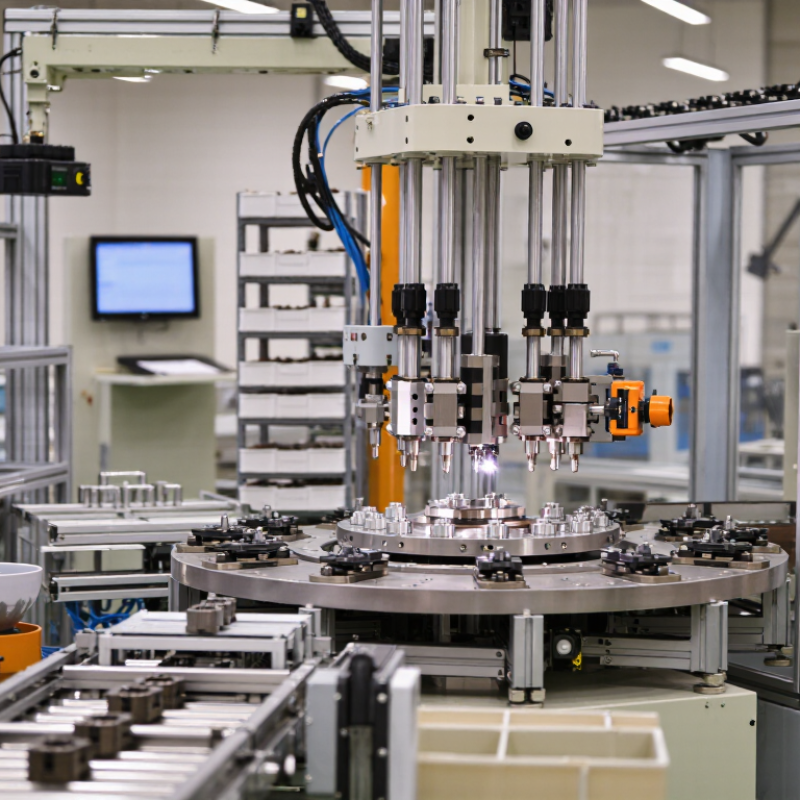
Rotary assembly machines move products around a circular table. Each station performs one task, such as inserting a spring or tightening a screw. They suit high-volume production with stable designs. Inline assembly machines move parts through a straight sequence of stations. Their layout is easier to expand, but they may require more floor space.

Indexing machines stop the workpiece at fixed positions before each operation. This improves placement accuracy and supports several processes in one cycle. Robotic assembly machines use programmable arms for flexible handling, part picking, and precise joining. They work well when product versions change often. Modular machines use separate units that can be added or adjusted later. Manual or semi-automatic systems remain useful for low-volume work and delicate components.

In practice, the best choice depends on product geometry, cycle time, tolerance, and maintenance skill. A fast machine is not always the most reliable. Poor feeding design can stop an entire line. I have seen teams focus on speed first, then discover that changeovers consume valuable hours. Clear access, simple tooling, and realistic testing often matter more than impressive output figures.

Key Applications and Selection Factors

What Is an Assembly Machine and How Does It Work?

An assembly machine joins separate components into a finished product. It may use feeders, robotic arms, fixtures, sensors, and fastening tools. Each station performs a defined task, such as pressing, screwing, welding, or dispensing adhesive. Sensors check position and presence before the next step begins. A controller coordinates timing, movement, and quality checks. This reduces repetitive labor and improves production consistency, although poorly adjusted equipment can repeat the same error quickly.

Key Applications and Selection Factors

Assembly machines support electronics, automotive parts, medical devices, appliances, and packaging equipment. They work best when component sizes and production steps remain reasonably consistent. Selection should begin with product geometry, materials, cycle time, accuracy, and expected output. Consider changeover time too. A machine that runs quickly may still waste money if new product variants require lengthy adjustments. Evaluate feeding reliability, available floor space, operator access, maintenance needs, and data-recording functions. Safety guarding and emergency controls must match the operating environment and applicable regulations. Do not select equipment from speed figures alone. Real production tests often reveal jams, vibration, or awkward maintenance access that brochures miss.

Tips: Test representative parts before purchase. Measure the complete cycle, including loading and inspection. Ask technicians to review cleaning points and spare-part access. Leave room for future tooling changes. A flexible machine may cost more initially, but rigid equipment can become expensive when product designs evolve. Record rejected parts during trials; small defects often expose larger process weaknesses.

What Is an Assembly Machine and How Does It Work?

Assembly machines combine components through operations such as feeding, positioning, fastening, pressing, welding, testing, and inspection. The chart compares representative operating-rate ranges commonly used when selecting an assembly system.

Higher output is generally associated with greater automation, but the final choice also depends on product complexity, required accuracy, changeover frequency, available floor space, maintenance capability, and integration with quality-control systems. The figures are representative engineering ranges rather than company-specific performance claims.